
Battery Swap Station Site Selection Checklist for Two-Wheeler Networks
2026-08-13
A local battery swapping network needs more than batteries and cabinets. It needs riders who will use the service, locations where they can swap, suitable vehicles, and people who can provide local support. HelloSwap helps partners combine compatible vehicles, swappable batteries, battery swapping cabinets, software, and deployment support into a connected two-wheeler battery swapping solution.

As the network operator, you own the local battery swapping business—but you do not need to do everything yourself. Before serving riders, you should assign these five specific roles to the right local partners.
Partner Type | What They Bring to the Network | Typical Examples |
Rider partner | Access to active riders and day-to-day rider communication | Delivery fleet, logistics company, rental operator, moto-taxi business, mobility platform |
Site partner | Locations where riders can access swap cabinets | Workshop, motorcycle dealer, retailer, parking operator, fuel station, property owner |
Vehicle partner | Suitable electric two-wheelers, vehicle service, or workshop capacity | Dealer, assembler, vehicle distributor, fleet workshop |
Service partner | Trained local support for cabinets, batteries, and connected vehicles | Authorized workshop, technical service provider, field-service team |
Technology & Solution partner | Swappable batteries, cabinets, software, vehicle adaptation support, compatible vehicle options, deployment support, and after-sales service | HelloSwap |
The roles are connected. A delivery company may bring riders but need a nearby workshop to support vehicles. A dealer may sell suitable motorcycles, host a swap cabinet, and provide workshop support. The structure is not fixed, but your network must cover all five functions.
For many projects, the best place to start is a company that already works with riders every day. That may be a delivery fleet, logistics operator, rental business, moto-taxi organization, or local motorcycle dealer with commercial customers.
This partner helps answer the first question: who will actually use the service?
Before entering a partnership, discuss the points below.
Question | Why It Matters |
How many electric two-wheelers are active each week? | It shows the likely starting user base |
Where do riders work most often? | It helps identify useful areas for swap cabinets |
Which vehicle models do riders use? | It shows whether existing vehicles can be supported or adapted |
Who communicates with riders? | The network needs a practical way to onboard users and share updates |
What problem does battery swapping solve for these riders? | The service should reduce a real charging, range, or downtime problem |
Who can make local decisions? | A project needs a responsible contact, not only a business introduction |
If your business already operates a commercial fleet or mobility platform, you can fill this role yourself. Otherwise, securing a rider partner is your first priority.
With rider access secured, evaluate what else your network needs to function. You may already own suitable properties or a vehicle workshop, but any missing capabilities must be covered by a partner.
A site partner provides a place where riders can swap batteries during their normal workday. The best site must be easy to enter, practical for parking, available during the right hours, and managed by someone who can resolve access issues.
Before selecting a site partner, confirm:
Who can approve cabinet placement
Whether riders can access the site during working hours
Whether there is enough space for rider access and parking
Who will act as the on-site contact
How the partner will notify you if site conditions change
A site partner may also be a workshop or dealer, but hosting a cabinet does not automatically make it responsible for technical maintenance.
A vehicle partner helps ensure riders have suitable electric motorcycles or scooters for the swapping network. This partner may be a dealer, assembler, distributor, fleet workshop, or vehicle operator.
HelloSwap can support two vehicle routes:
Adapt an existing fleet. If a partner already operates suitable electric two-wheelers, HelloSwap can assess whether those models can be adapted for use with the HelloSwap swapping system.
Provide or coordinate compatible vehicles. If a partner does not have its own vehicle source, HelloSwap can provide or coordinate vehicle options that work with the batteries and swap cabinets used in the project.
The right route depends on the resources already available locally. A delivery company with an existing electric fleet may need adaptation support. A new rental business or distributor may need vehicles, batteries, cabinets, and software arranged together.
A service partner provides local support when a rider, site host, or operating partner needs help. This may be an authorized workshop, a technical service provider, or a trained field team.
The service arrangement should answer five basic questions.
Question | What Should Be Clear |
Where should an issue be reported? | One contact channel for riders and partners |
Who responds first? | The local service contact or support team |
What can be handled locally? | The work covered by local training and authorization |
When should the issue be escalated? | The point at which HelloSwap technical support becomes involved |
Who updates the rider or site host? | The person responsible for communicating progress |
This gives riders, site hosts, and local partners a clear route for reporting an issue and receiving support.
Verify Capability Before Contracting: Before finalizing any of these roles, verify their capabilities in person. Meet the local managers, visit potential sites, and check what a workshop can support in practice. Do not rely on a company's brand size alone.
Verifying local capability is only the first step; the next is defining exactly who is responsible for what. Most problems in a partner network happen at the handoff points—when partners assume someone else is handling a site access issue, a vehicle repair, or a technical fault.
A responsibility matrix prevents these gaps by clearly separating your role as the operator from the roles of your partners.
Network Activity | Lead Owner | Supporting Partners |
Rider recruitment and first-line communication | Rider partner | Network Operator (You) |
Local vehicle supply and workshop support | Vehicle partner | Network Operator (You) |
Vehicle adaptation assessment and technical configuration | HelloSwap | Vehicle partner, Network Operator (You) |
Cabinet location access and site coordination | Site partner | Network Operator (You), Service partner |
Technical issue reporting and first response | Service partner | Site partner, HelloSwap |
The agreement should also explain how partners handle changes. For example:
Who approves a new cabinet location?
Who tells riders when access to a site changes?
Who updates the local service contact?
Who coordinates a new vehicle source or fleet-adaptation request?
Clear answers prevent partners from passing problems from one company to another while riders wait for support.
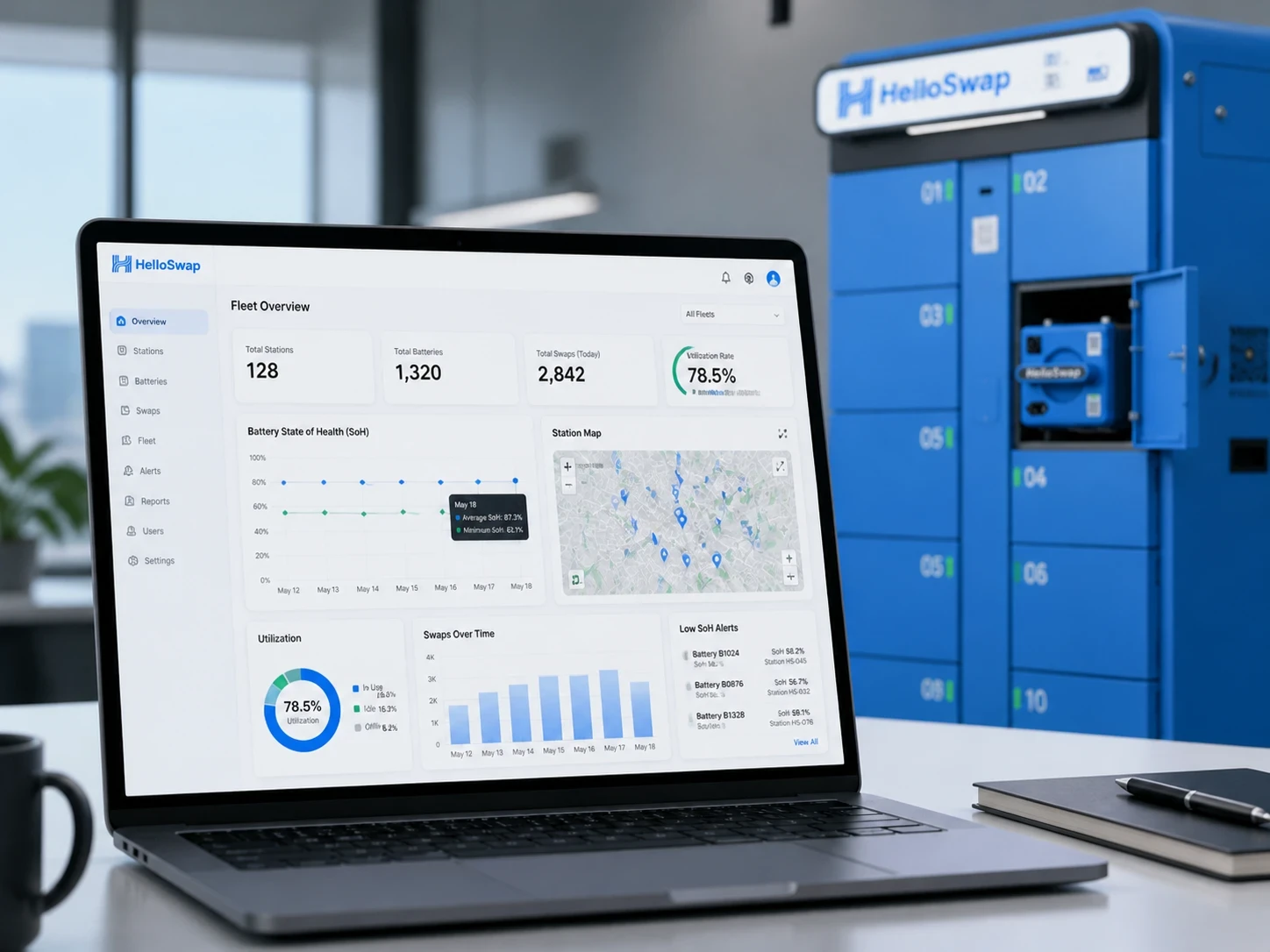
Once responsibilities are defined, partners need a shared system to execute them. If everyone works from different spreadsheets and informal messages, a simple issue at a swap site can cause days of confusion.
HelloSwap's software platform provides a single source of truth, giving partners access to exactly what they need to fulfill their roles:
Rider partners can manage their users and track vehicle activity.
Site partners can report location issues directly to the network.
Service partners can receive, update, and close technical support requests in real time.
You, as the network operator, maintain full visibility over cabinet status, swap transactions, and partner performance.
By keeping everyone on the same platform, you ensure that when a handoff happens, the right partner has the information they need to act immediately.
A practical two-wheeler battery swapping network requires the right combination of rider access, sites, vehicles, local service, and connected operating tools. Backed by Hello Inc., Ant Group, and CATL, HelloSwap works with network operators, fleet managers, vehicle partners, site hosts, workshops, and distributors to build battery swapping networks for local markets.
Contact HelloSwap to assess your local partner structure, explore vehicle supply or fleet-adaptation options, align site and service resources, and build a connected two-wheeler battery swapping network.
Contact Us
Location
2F, Building 1, No.898 XiuWen Road, MinHang District, Shanghai, China
Copyright © 2024 福建宁德惠智无限科技有限公司 All Rights Reserved. 闽ICP备2023025900号-3.


